

Academy
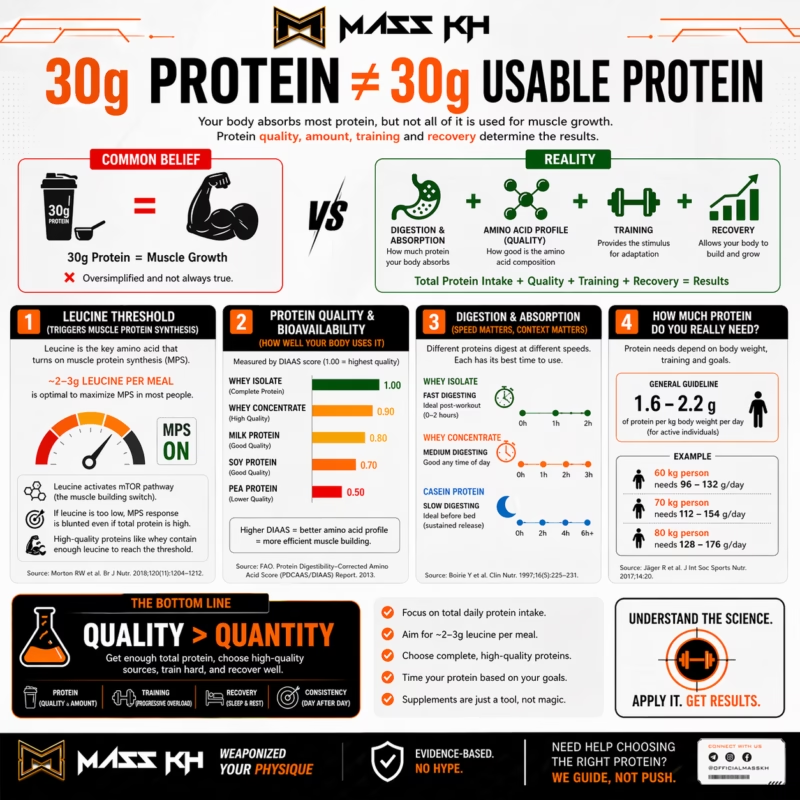
30g Protein ≠ 30g Usable Protein
Apr
Understanding What Actually Builds Muscle
Most people simplify muscle growth into one idea:
“Eat 30g of protein → build muscle.”
It sounds logical. It’s easy to remember.
But it’s also incomplete and often misleading.
Your body does absorb most of the protein you consume.
However, absorption is not the same as utilization.
What actually matters is how much of that protein your body can use for muscle protein synthesis (MPS) the process responsible for building and repairing muscle tissue.
The Reality: Muscle Growth Is a System, Not a Number
Muscle growth doesn’t depend on a single meal or a fixed protein number.
It’s influenced by multiple interconnected factors:
- Total daily protein intake
- Amino acid profile (especially leucine)
- Protein quality and bioavailability
- Training stimulus (progressive overload)
- Recovery (sleep, consistency, stress management)
Think of protein intake as one piece of a larger system—not the entire equation.
1. The Leucine Threshold: The Real Trigger
At the center of muscle growth is a key amino acid: leucine.
Leucine acts as a signal that “turns on” muscle protein synthesis.
What matters:
- You need approximately 2–3g of leucine per meal to effectively trigger MPS in most individuals.
- If your protein source is low in leucine, even high total protein intake may not fully stimulate muscle growth.
Why this matters:
Not all protein sources are equal.
For example:
- Whey protein is rich in leucine → highly effective
- Plant proteins may require larger servings or combinations to reach the same threshold
👉 This is why quality matters more than just hitting a number.
2. Protein Quality & Bioavailability
Protein isn’t just about grams it’s about how usable those grams are.
Measured by DIAAS (Digestible Indispensable Amino Acid Score):
- 1.00 = highest quality
- Reflects amino acid completeness + digestibility
Example breakdown:
- Whey Isolate → ~1.00 (excellent)
- Whey Concentrate → ~0.90
- Milk Protein → ~0.80
- Soy Protein → ~0.70
- Pea Protein → ~0.50
Key takeaway:
Higher quality protein:
- Contains all essential amino acids
- Is easier to digest and absorb
- Is more efficient at building muscle
👉 Better amino profile = better results per gram
3. Digestion Speed: Timing Matters (But Not How You Think)
Different proteins digest at different speeds:
Fast-digesting:
- Whey Protein
- Ideal post-workout
- Rapid amino acid delivery
Medium-digesting:
- Whey Concentrate / mixed meals
- Suitable throughout the day
Slow-digesting:
- Casein Protein
- Ideal before sleep
- Sustained amino acid release
Important:
Timing can optimize results but it doesn’t override fundamentals.
👉 If your daily protein intake is insufficient, perfect timing won’t save you.
4. Total Daily Protein Intake: The Foundation
No matter how optimized your meals are,
your total intake across the day is what drives progress.
General guideline:
1.6 – 2.2g of protein per kg of bodyweight (for active individuals)
Example:
- 60kg → 96–132g/day
- 70kg → 112–154g/day
- 80kg → 128–176g/day
Why this matters:
Muscle growth is a cumulative process, not a single-meal event.
👉 Consistency over time beats perfection in one meal.
5. Training Stimulus: Protein Needs a Reason
Protein alone doesn’t build muscle.
Training provides the signal.
Protein provides the materials.
Without:
- Progressive overload
- Proper intensity
- Structured training
👉 Your body has no reason to build new muscle tissue
6. Recovery: Where Growth Actually Happens
Muscle isn’t built in the gym it’s built during recovery.
Key recovery factors:
- Sleep quality
- Rest days
- Stress management
- Nutrient timing consistency
Even with perfect nutrition and training:
👉 Poor recovery = limited results
The Bottom Line: Quality > Quantity
You don’t need to overcomplicate things but you do need to understand them correctly.
Focus on what actually works:
✔ Hit your total daily protein intake
✔ Prioritize high-quality, complete protein sources
✔ Aim for ~2–3g leucine per meal
✔ Train with intent and progression
✔ Recover properly and stay consistent
Supplements: A Tool, Not the Foundation
Protein powders like whey are useful because they are:
- Convenient
- High quality
- Efficient in hitting daily targets
But they are not magic.
👉 They support your system—they don’t replace it.
No Hype. Just Fundamentals.
There are no shortcuts in building a strong physique.
Only:
- Consistency
- Structure
- Smart decisions over time
MASS KH
Weaponized Your Physique
Evidence based. No hype.
If you’re not sure which protein fits your goal, body, and budget
we guide you based on what actually works, not what just sells.

